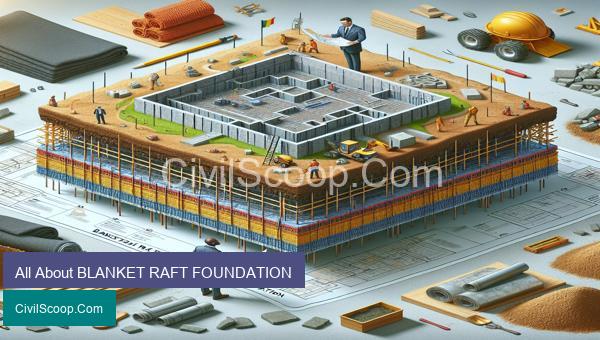
For centuries, foundations have played a crucial role in the construction and stability of buildings. One type of foundation that has gained popularity in recent years is the blanket raft foundation. This innovative technique involves using a layer of soil that spans the entire footprint of the building, providing a solid base for the structure above. In this article, we will dive into the ins and outs of blanket raft foundation, exploring its benefits, construction process, and key considerations for implementation. Whether you are a homeowner, builder, or simply curious about construction techniques, this guide to blanket raft foundation will provide you with all the information you need.
Table of Contents
BLANKET RAFT FOUNDATION
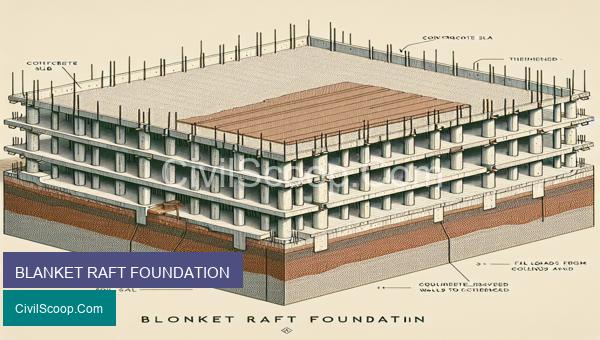
A blanket raft foundation, also known as a slab-on-grade foundation, is a type of shallow foundation commonly used in construction. It is a flat, horizontal concrete slab that is cast directly on the ground on which a structure is to be built.
This type of foundation is suitable for a wide range of structures, including residential, commercial, and industrial buildings. It is typically used on sites with good soil conditions, where the soil is uniform and can adequately support the weight of the structure.
The construction process for a blanket raft foundation involves excavating the ground to a uniform depth, usually around 1-2 feet. The excavated area is then filled with layers of compacted gravel and leveled to create a stable base. This process helps to distribute the weight of the structure evenly and prevent differential settlement.
A moisture barrier, such as a plastic sheet, is then placed on top of the compacted base to prevent moisture from seeping up into the concrete. This is particularly important in areas with high water tables.
Steel reinforcement, such as rebar, is then placed on top of the moisture barrier, creating a grid-like pattern. The reinforcement helps to strengthen the concrete and prevent cracking.
Next, the concrete is poured over the entire area and leveled to a smooth finish. The thickness of the concrete slab varies depending on the weight of the structure and the soil conditions, but it is typically around 4-6 inches thick.
One of the advantages of a blanket raft foundation is its cost-effectiveness. It requires less excavation and materials compared to other types of foundations, such as pile or basement foundations. It also allows for easier access to plumbing and electrical systems, making future maintenance and repairs more straightforward.
Additionally, a blanket raft foundation provides excellent thermal insulation, as it is in direct contact with the ground. This can help to reduce heating and cooling costs for the building.
However, there are some limitations to consider when using a blanket raft foundation. Since it is a shallow foundation, it may not be suitable for sites with poor soil conditions, such as expansive or highly organic soils. It also has limited load-bearing capacity, so it may not be suitable for heavy structures or buildings with multiple floors.
In conclusion, a blanket raft foundation is a versatile and economical option for building foundations. Its construction process is relatively simple, making it a popular choice for many construction projects. However, it is essential to consider the site’s soil conditions and the weight of the structure to determine if a blanket raft foundation is the most appropriate option.
Conclusion
In conclusion, the blanket raft foundation is a cost-effective, versatile, and environmentally friendly option for building foundations in challenging soil conditions. This innovative technique not only provides a stable base for structures, but also minimizes the negative impact on the surrounding environment. Whether for residential, commercial, or industrial projects, the blanket raft foundation offers numerous benefits such as reduced construction time, increased flexibility in design, and enhanced durability. As construction methods continue to evolve, the blanket raft foundation stands out as a reliable and sustainable solution for building foundations.