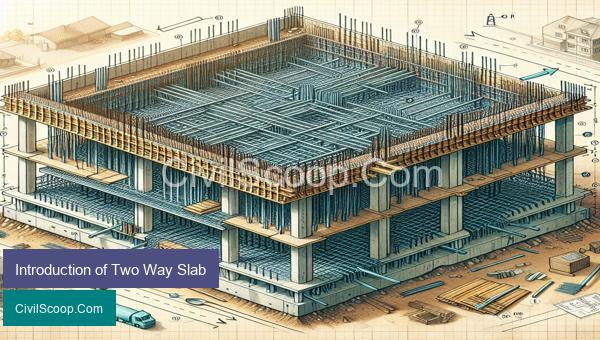
A two way slab is a reinforced concrete structural element widely used in the construction industry for its efficiency and flexibility in design. It is a type of slab that is supported by beams on all four sides, allowing for load transfer in both directions. Two way slabs are commonly used in buildings, bridges, and other structures to provide a strong and stable flooring system. In this article, we will explore the basics of two way slabs, their advantages and applications, and the methods of designing and constructing them. Whether you are a professional in the field or a curious reader, this article aims to provide you with a comprehensive understanding of the introduction of two way slabs.
Table of Contents
Minimum Thickness of Two Way Slab as per ACI 318-11 for Deflection Control
In the field of civil engineering, minimum thickness of two way slab plays a crucial role in the design and construction of a building. The American Concrete Institute (ACI) 318-11 provides guidelines for the minimum thickness of two way slabs in order to control deflection.
Deflection of a structure refers to the deformation or bending of the members under applied loads. Excessive deflection can lead to cracking, failure, and overall structural instability. Therefore, it is important to control deflection in structural design.
According to ACI 318-11, the minimum thickness of a two way slab should be at least h/25 where h is the clear span of the slab. This means that the thickness of the slab should not be less than 1/25th of its span. This is applicable for both interior and exterior slabs.
In simpler terms, the minimum thickness of a two way slab can be calculated by dividing the clear span of the slab by 25. For example, if the clear span of a slab is 20 feet, then the minimum thickness should be 20/25 = 0.8 feet or 9.6 inches.
However, this minimum thickness requirement may be increased to h/20 where h is the clear span of the slab, in the following cases:
1. For slabs supporting light partitions or non-load bearing walls.
2. For slabs with superimposed loads less than 100 psf.
3. In regions with high winds or seismic activity.
4. For exterior slabs that are exposed to freezing and thawing conditions.
In addition to the minimum thickness requirement, ACI 318-11 also specifies limits on deflection. For interior slabs, the total deflection should not exceed span/360 and for exterior slabs, it should not exceed span/240.
The minimum thickness and deflection limit requirements are based on the assumption that the slab is simply supported and that the average modulus of elasticity of the concrete in the compression zone is not less than 4,000 psi.
It is important to note that these are minimum requirements and the actual thickness of the slab should be determined based on the specific design criteria and loading conditions. It is always recommended to use the minimum thickness as a starting point and then make adjustments based on other factors such as live load, dead load, and design criteria for a specific project.
In conclusion, the minimum thickness of a two way slab should be at least h/25 where h is the clear span of the slab, in order to control deflection as per ACI 318-11 guidelines. This requirement may be increased in certain cases to h/20. These requirements should be followed strictly in order to ensure the safety and stability of the structure.
Conclusion
In conclusion, the introduction of two way slabs has revolutionized the construction industry by providing a more efficient and cost-effective method of building. Its ability to distribute loads in both directions has made it a popular choice for various structures such as residential, commercial, and industrial buildings. From its history and design principles to its advantages and disadvantages, understanding the fundamentals of two way slabs is crucial for architects, engineers, and contractors. With proper planning, design, and construction, two way slabs can provide a strong and durable foundation for any type of structure. As technology and construction methods continue to progress, the use of two way slabs is expected to increase, further solidifying its importance in the building industry.