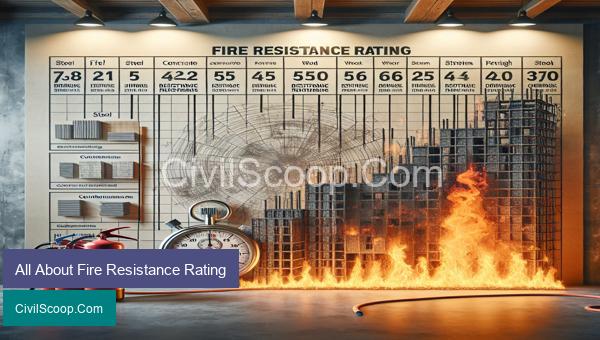
Fire resistance rating is an essential aspect of building design and construction. It refers to the ability of a material, structure, or assembly to withstand fire or to prevent its spread. In an event of fire, buildings with a high fire resistance rating can significantly reduce the damage caused and provide valuable time for occupants to evacuate safely.
Understanding the concept of fire resistance rating is crucial for architects, engineers, and building owners as it plays a significant role in ensuring the safety of a structure and its occupants. In this article, we will delve into the details of fire resistance rating, its importance, and how it is determined.
Table of Contents
What is Fire Resistance Rating (FRR) in Construction?
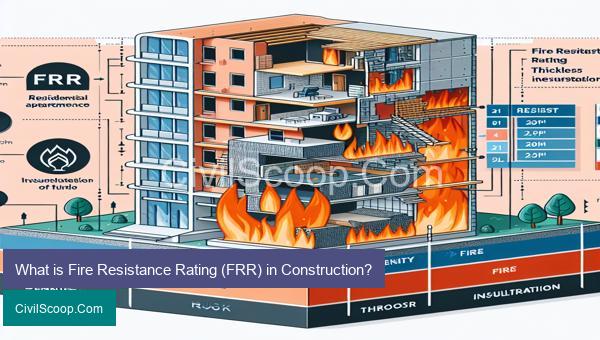
Fire resistance rating (FRR) is a crucial aspect of construction that pertains to a building’s ability to withstand fire for a specific amount of time without collapsing or causing significant damage. FRR is used to measure the fire safety of a building and is an important consideration in the design, construction, and maintenance of all types of structures.
The FRR of a building or a structural element is determined by conducting standardized fire resistance tests, which are usually carried out in specialized laboratories.
These tests measure the time it takes for a designated building or structural element to fail under specific fire conditions. The results of these tests are used to assign a fire resistance rating to the building or element.
There are several different types of fire resistance ratings, and they are typically denoted by a specific number of hours, such as 1 hour (60 minutes), 2 hours (120 minutes), 3 hours (180 minutes), and so on. These ratings indicate how long a building or structural element can withstand fire before it fails.
For example, a building with an FRR of 2 hours means that it can resist fire for 2 hours before it starts to fail.
The FRR of a building depends on various factors, such as its structural design, the materials used in its construction, and the fire load within the building. The fire resistance of various building elements, such as walls, floors, and ceilings, can also vary, depending on the materials and construction techniques used.
For instance, fire-rated walls are designed to prevent the spread of fire between different parts of a building, while fire-resistant floors are meant to withstand high levels of heat and flames.
In addition to structural considerations, the FRR of a building is also impacted by the fire protection systems and measures in place.
These may include fire alarms, smoke detectors, sprinkler systems, fire-resistant doors and windows, and fire-retardant coatings for building materials. All these measures play a crucial role in increasing the FRR of a building and ensuring its overall fire safety.
FRR is a fundamental aspect of building code regulations, and local authorities often require that buildings meet specific FRR standards.
This ensures that buildings can withstand fire for a designated period, allowing time for occupants to evacuate safely and for emergency services to arrive and contain the fire.
Features of Fire Resistance Ratings (FRR)
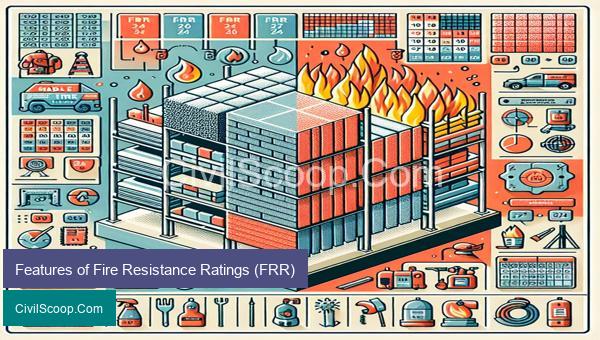
Fire resistance ratings (FRR) are an important aspect of building design and construction, especially in ensuring the safety and protection of the occupants and the structure itself.
The FRR denotes the ability of a material or assembly to withstand fire for a certain period of time without losing its structural integrity, thus allowing occupants to safely evacuate the building and providing time for firefighters to control the fire.
The primary purpose of FRR is to prevent the rapid spread of fire and limit its potential damage to the building. Here are some of the key features of FRR:
1. Time duration:
The first and most crucial feature of FRR is the duration for which a material or assembly can withstand fire. This duration is denoted by a specific number of minutes or hours, such as 60, 90, or 120 minutes. The higher the FRR, the longer the material or assembly can resist fire.
2. Material type:
Various building materials have different levels of fire resistance, and their FRR ratings will vary accordingly. For example, concrete and steel have a higher FRR compared to wood or gypsum. The type of material used in construction has a significant impact on the overall FRR of the building.
3. Assembly construction:
FRR is also affected by the way building materials are assembled and installed. An assembly with proper sealing, gaps, and joints will have a higher FRR compared to one with poor construction.
4. Temperature range:
The FRR of a material is also determined by the temperature range it can withstand without losing its structural integrity. This is known as the critical temperature, and it varies for different materials. For instance, concrete can resist higher temperatures compared to steel.
5. Transmittance:
The FRR also takes into account the amount of heat transmitted through a material or assembly. Lower transmittance means the material has a higher FRR.
6. Structural adequacy:
Another key feature of FRR is the structural adequacy, which refers to the ability of the material to maintain its load-bearing capacity during a fire. A material with good structural adequacy will have a higher FRR.
7. Smoke and toxicity:
Apart from the duration of fire resistance, FRR also considers the amount of smoke and toxic gases emitted during a fire. Materials with low smoke and toxicity have a higher FRR.
8. Testing standards:
FRR is determined through various standardized fire tests, such as the ASTM E119, UL 263, and NFPA 251. These tests subject materials to varying temperature and fire exposure, and their performance determines their FRR rating.
How is FRR measured?
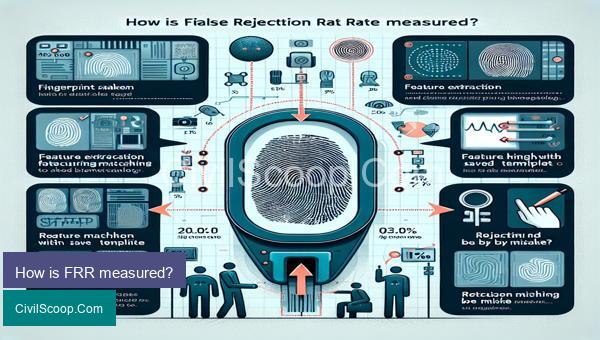
FRR (Floor Flatness and Levelness Repetitiveness) is a measure of the flatness and levelness of a concrete floor. It is an important characteristic in building construction, especially for floors in industrial or commercial structures where equipment and machinery need to be installed.
The measurement of FRR is conducted using specialized equipment called a profilograph. This device consists of a carriage with a wheel that is pulled over the concrete surface, recording the elevations at various points. The data collected is then used to generate a 3D graphical representation of the floor surface.
The FRR measurement is typically taken in terms of floor flatness (FF) and floor levelness (FL). FF measures the variation in the flatness of the floor surface, while FL measures the variation in the levelness or slope of the floor. Both of these measurements are expressed in terms of F-numbers, which represent the deviation from a perfectly flat and level surface.
To measure the FF and FL, the profilograph is run in two perpendicular directions – the longitudinal direction (along the length of the floor) and the transverse direction (across the width of the floor). This creates a grid of data points, which are then analyzed to determine the average F-numbers for FF and FL.
The American Concrete Institute (ACI) has set standards for acceptable FF and FL values for different types of floors. The most common standards are FF50/FL35, which means that in a 10-foot diameter circle, no point should deviate more than 1/2 inch above or below the average floor elevation (FF50) and no point should deviate more than 1/4 inch above or below the average slope (FL35).
The FRR measurement is important because it ensures that the concrete floor meets the required standards for smoothness and levelness. A poorly measured FRR can result in an uneven floor surface, which can cause damage to equipment and affect the overall functionality of the building.