
Digital theodolites are powerful surveying instruments used for accurate angle and distance measurements in various construction, engineering, and mapping applications. These advanced devices have revolutionized the way surveyors and engineers collect and analyze data, providing more efficient and precise results. In this article, we will explore the inner workings of digital theodolites, their components, and how they are used in the field. We will delve into the technology behind these instruments, their key features, and advantages over traditional theodolites. Whether you are a professional surveyor or simply interested in the world of advanced surveying equipment, this article will provide a comprehensive understanding of the working principles of digital theodolites.
Table of Contents
Important Parts and Working of Digital Theodolite
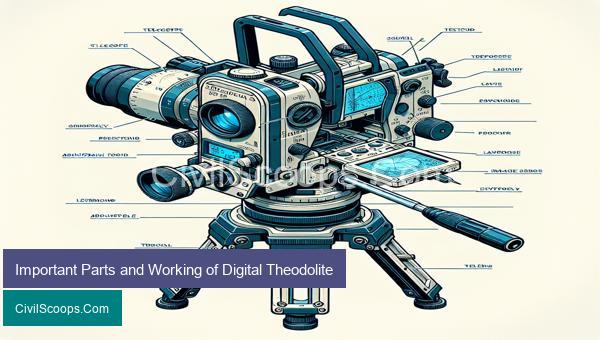
A digital theodolite is an advanced surveying instrument used to measure angles and distances in the field. It consists of several important parts that work together to accurately determine horizontal and vertical angles, as well as distances. In this article, we will discuss the important parts and working of a digital theodolite in detail.
Important Parts:
1. Telescope: The telescope is the main part of a digital theodolite. It is a long tube with a lens at each end, used to measure the angle between two points. The eyepiece is located at one end, and the objective lens is located at the other end.
2. Electronic Display: Unlike traditional theodolites, digital theodolites have a built-in electronic display, usually located on top of the telescope. The display shows the measured horizontal and vertical angles as well as other information such as horizontal and vertical distance, slope distance, and elevation.
3. Electronic Level: The electronic level is a small bubble-like vial located on top of the theodolite. It is used to ensure that the instrument is set up on a level surface before taking measurements.
4. Horizontal and Vertical Index Wheels: These are two circular discs located on the sides of the theodolite. They are used to measure horizontal and vertical angles, respectively. The user can rotate these wheels to align the instrument with the desired angle.
5. Tribrach: The tribrach is a base on which the theodolite is mounted. It has three adjusting screws that help in setting up the instrument in a stable and level position.
6. Collimation Knob: The collimation knob is used to adjust the horizontal and vertical alignment of the telescope. It is usually located near the base of the telescope and helps to aim the telescope at the desired point.
7. Battery Compartment: As digital theodolites are electronic devices, they require batteries to function. The battery compartment is usually located on the side of the instrument and can be easily accessed for battery replacement.
Working:
1. Setting Up: The first step in using a digital theodolite is to set it up on a stable and level surface. The tribrach and leveling screws are adjusted to ensure that the instrument is level.
2. Measuring Horizontal and Vertical Angles: The user aims the theodolite at the desired point, and the horizontal and vertical index wheels are rotated to align with the target. The angles are then displayed on the electronic display.
3. Measuring Distance: Digital theodolites are equipped with a laser or infrared EDM (Electronic Distance Measurement) system. The user can aim the laser at the target, and the instrument will measure the slope distance and display it on the electronic display.
4. Calculating Elevation and Height: By measuring the vertical angle and distance to the target, the digital theodolite can calculate the elevation and height of the target.
5. Saving and Exporting Data: Digital theodolites have a memory function that can store measurements. The data can be downloaded to a computer and used for further analysis or exported to other software for mapping and drafting.
In conclusion, a digital theodolite is an essential tool in the field of surveying. Its accurate and efficient measurements make it a preferred choice for civil engineers. With its modern features and easy-to-use interface, the digital theodolite has revolutionized the way surveying is
Parts of a Digital Theodolite
A digital theodolite is a highly advanced and precise instrument used in land surveying, engineering and construction. It is a modern version of the traditional theodolite, which is a measuring device used to determine horizontal and vertical angles between points.
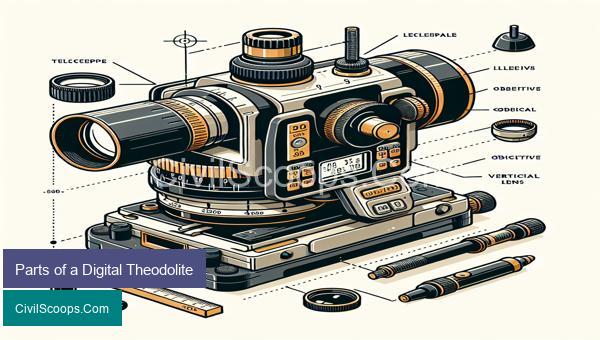
A digital theodolite consists of various parts and components that work together to help surveyors accurately measure angles, distances and elevations. Some of the key parts of a digital theodolite are as follows:
1. Telescope:
The telescope is the main part of a digital theodolite that allows the user to view both vertical and horizontal angles. It is equipped with a reticle, which is a crosshair-like pattern that helps in precise targeting. The telescope can be rotated horizontally and vertically, allowing the surveyor to measure angles in any direction.
2. Rotary scale:
The rotary scale is a circular plate that is used to measure horizontal angles from the center of the instrument. It is calibrated in degrees and can be rotated using the horizontal axis.
3. Vertical circle:
The vertical circle is a graduated circle that is used to measure vertical angles. It is mounted vertically on the telescope and can be rotated using the vertical axis. The vertical circle is calibrated in degrees or gon, which is a unit of measurement used in surveying.
4. Magnifier:
The magnifier is a small lens attached to the front of the telescope. It provides a clearer view of the reticle and helps in more accurate measurements.
5. Electronic display:
The electronic display is a crucial part of a digital theodolite as it shows the measured values of angles, distances, and elevations. It is also used to input data and perform various operations using the control buttons.
6. Control buttons:
The control buttons are used to operate the digital theodolite and perform various functions such as setting the instrument, inputting data, and displaying results on the electronic display.
7. Laser pointer:
Many modern digital theodolites are equipped with a laser pointer, which helps in precise targeting and measurement of distant objects. The laser beam is used to align the instrument and target the desired point accurately.
8. Tribrach:
The tribrach is a tripod mount that holds the digital theodolite in place. It is designed to be rigid and stable to ensure accurate measurements.
9. Battery compartment:
The battery compartment is where the batteries are inserted to power the digital theodolite. It is usually located on the side or the base of the instrument.
10. Microprocessor:
The microprocessor is the brain of the digital theodolite. It receives and processes data from the various sensors and displays the results on the electronic display. It also controls the overall functioning of the instrument.
Overall, a digital theodolite is a complex instrument that combines multiple components and advanced technology to provide precise and accurate measurements. Each part plays a crucial role in the functioning of the instrument, and any damage or malfunction can affect the accuracy of the measurements. Therefore, it is essential to handle and maintain a digital theodolite carefully to ensure optimal performance.
Conclusion
In conclusion, the digital theodolite has significantly revolutionized the field of surveying and measuring angles. Its advanced technology and user-friendly interface make it a valuable instrument for accurate and efficient measurements. Understanding the inner workings and components of a digital theodolite is crucial for its proper operation and maintenance. With its high precision and real-time data collection capabilities, the digital theodolite has become an essential tool for various industries such as construction, engineering, and land surveying. As technology continues to advance, we can only expect further improvements in the digital theodolite, making it an invaluable asset for precise and reliable measurements in the future.