
STRAP FOOTING is a commonly used foundation type in the construction industry that provides stability and support to buildings and structures. Designed to distribute the weight of the load evenly, this type of foundation is particularly useful in areas with poor soil conditions or when building on uneven terrain. In this article, we will delve into the details of STRAP FOOTING, discussing its features, benefits, and applications, as well as the factors to consider when choosing this type of foundation for your next construction project. Whether you are a homeowner, architect, or builder, understanding the basics of STRAP FOOTING can help you make informed decisions and ensure the success of your building project.
Table of Contents
STRAP FOOTING
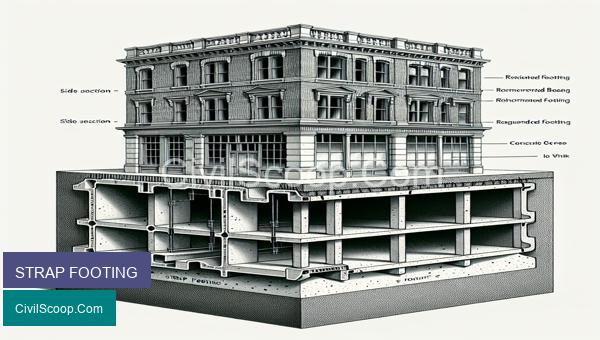
A strap footing, also known as a combined or cantilevered footing, is a type of foundation used in construction to distribute the load of a structure over a larger area. It is commonly used when the soil conditions are not able to support the entire load of the structure on its own.
In a strap footing, two or more columns of a building are connected by a concrete beam or strap, which runs under the foundation. The strap is usually constructed of reinforced concrete and is wider than the columns it connects. This creates a larger base area and helps redistribute the load to a wider area of the soil. The strap footing is suitable for both low-rise and high-rise buildings.
The main purpose of a strap footing is to increase the stability of a building and provide a more even distribution of the weight of the structure. This is especially important in areas with weak or uneven soil conditions, where the traditional individual footings may not be enough to support the structure. By combining multiple column loads into a single footing, the bearing capacity of the soil is increased, reducing the risk of settlement or failure.
The design of a strap footing is crucial to ensure the stability and durability of a structure. It must take into account the location and size of the columns, the type of soil, and the expected loads. The depth of the strap footing is also an important factor, as it must be deep enough to transfer the load to a stable layer of soil. The size and reinforcement of the strap must also be carefully calculated to withstand the applied loads and prevent cracking or failure.
In addition to providing stability, strap footings also offer economic advantages over traditional footings. Since fewer footings are needed, they require less excavation and concrete, reducing construction costs and time. Additionally, they can be used in areas with varying soil conditions, eliminating the need for different types of foundations within a single structure.
In conclusion, strap footing is an effective and efficient foundation type that helps distribute the weight of a building over a larger area of soil. It is a suitable solution for structures with multiple columns, weak soil conditions, or limited space for individual footings. Proper design and construction of strap footings are crucial for the stability and longevity of a building. As a civil engineer, it is important to carefully consider the soil conditions and load requirements when designing a strap footing to ensure the safety and structural integrity of the building.
Conclusion
In conclusion, STRAP FOOTING is a crucial aspect of structural engineering that provides stability and strength to a building’s foundation. It is important to understand the various types and functions of strap footing, as well as the factors to consider when designing and constructing them. With proper planning and implementation, STRAP FOOTING can effectively distribute the load and prevent settlement of the structure. It is also important to regularly inspect and maintain strap footing to ensure the stability and safety of the building. As new technologies continue to emerge, strap footing will continue to evolve and play a vital role in the construction of safe and durable buildings.