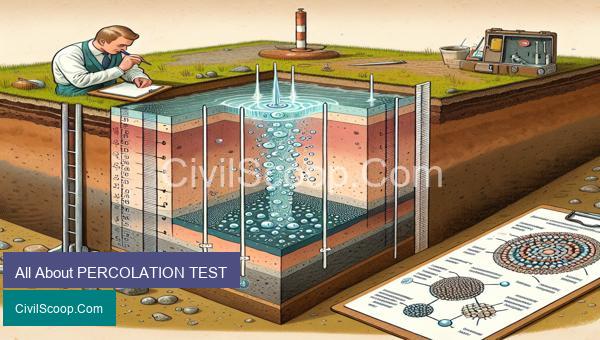
Percolation test, also known as a perc test, is an essential evaluation tool used in determining the suitability of a piece of land for septic system installation. This test measures the rate at which a specific volume of water can percolate through the soil, providing crucial information about the soil’s ability to absorb and filter wastewater. In this article, we will delve into the concept of percolation testing, its importance in the planning and design of septic systems, and the factors that can influence its results. Understanding the percolation test is crucial for homeowners, builders, and developers involved in the construction or renovation of properties in areas without a municipal sewage system. So, let’s explore all about percolation tests and how they
Table of Contents
PERCOLATION TEST- SOIL ABSORPTION CAPACITY
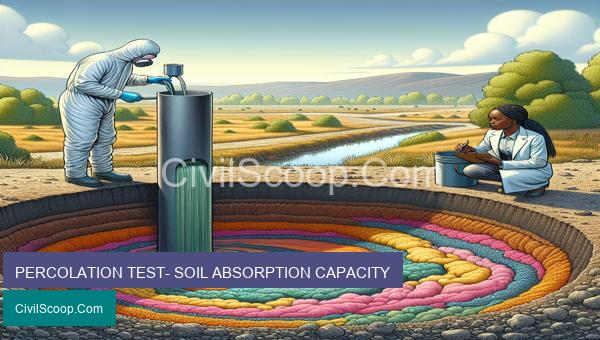
Percolation test, also known as soil absorption capacity test, is a process used to determine the rate at which water can absorb into the soil, which is an important factor for the design and construction of structures such as septic systems, roads, and landfills. It is an essential test for civil engineers as it helps them to determine the suitability of soil for different construction projects.
The test involves digging a large hole in the ground, usually 12-24 inches deep and at least 6 inches in diameter. The bottom of the hole is then filled with water, and the rate at which the water drains into the soil is measured. This test is based on the principle of gravity flow, where the rate of water absorption is directly proportional to the head of water above the soil.
There are two different methods of conducting a percolation test: the constant-head method and the falling-head method. In the constant-head method, the water is maintained at a constant depth throughout the test period, and the time taken for the water level to drop is measured. On the other hand, in the falling-head method, the water level is allowed to drop at a constant rate, and the time taken for the water to drain from a certain depth is measured.
The results of the percolation test are usually reported in the time it takes for the water level to drop by one inch, also known as the percolation rate. This rate is then used to calculate the soil absorption capacity, which is the volume of water that can be absorbed by the soil per unit area in a given time.
The soil absorption capacity of a particular location is affected by various factors such as soil type, texture, structure, and compaction. For instance, sandy soils have a higher absorption capacity compared to clay soils, which have smaller particles and thus less permeable. Additionally, the presence of impermeable layers or high groundwater levels can significantly affect the results of the percolation test.
The results of the percolation test are crucial in determining the size and design of septic systems. In areas where municipal sewers are not available, septic systems are the primary method of treating sewage. The percolation test helps in determining the size of the septic system necessary to handle the expected volume of wastewater based on the soil absorption capacity.
Apart from septic systems, the percolation test is also essential in the design of roads and landfills. In road construction, the test helps engineers to determine the appropriate drainage system and the level of permeability required for the road base. Similarly, in the design of landfills, the test is used to determine the soil absorption capacity and the suitability of the site for waste disposal.
In conclusion, percolation test is a fundamental test in the field of civil engineering. It helps in determining the suitability of soil for various construction projects and plays a significant role in ensuring the safety and functionality of structures such as septic systems, roads, and landfills. Therefore, it is essential to conduct this test before commencing any construction project to ensure its success.
Conclusion
In conclusion, percolation tests are an essential tool for determining the potential for soil to absorb water and in turn, its suitability for various projects such as septic systems and stormwater management. Understanding the process and factors that affect the results of percolation tests can greatly benefit engineers, builders, and homeowners in making informed decisions and ensuring the success of their projects. By following proper protocols and obtaining accurate results, percolation tests can effectively protect the environment and promote sustainable development. With continuous research and advancements in methodology, the future of percolation testing looks promising in providing valuable insights for construction and land use planning.