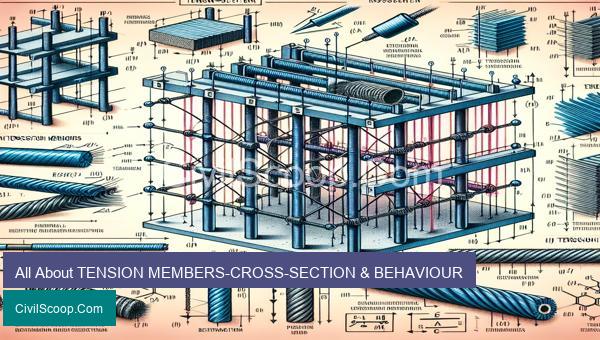
Tension members are critical structural elements that are designed to resist axial forces, also known as tension forces, within a structure. They play a crucial role in maintaining the stability and functionality of various constructions, from buildings and bridges to machinery and vehicles. Understanding the behavior and cross-section of tension members is essential for engineers and architects to ensure the structural integrity and safety of their designs. In this article, we will delve into the key aspects of tension members, including their cross-section designs and behavior under different loading conditions. By the end, we hope to provide a comprehensive understanding of all that goes into creating robust and efficient tension members.
Table of Contents
TENSION MEMBERS-CROSS-SECTION & BEHAVIOUR
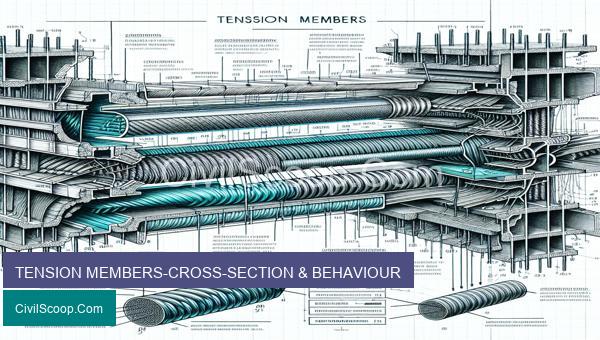
Tension members are structural elements designed to resist axial tensile forces. These forces act to pull the member apart, causing it to elongate. In civil engineering, tension members are commonly used in structures such as bridges, roof trusses, crane beams, and other structural systems.
One important aspect of designing tension members is selecting an appropriate cross-sectional shape. The cross-section not only affects the structural performance of the member but also plays a crucial role in the overall aesthetic appearance of the structure.
Following are some of the commonly used cross-sectional shapes for tension members:
1. Rectangular or square cross-section: This is the simplest and most commonly used shape for tension members. It offers high strength in both the horizontal and vertical directions, making it suitable for a wide range of applications.
2. Circular cross-section: This shape offers uniform strength in all directions and is often used in cables and wires. It also has a sleek and aesthetically appealing appearance.
3. Tapered cross-section: This shape offers higher strength at the ends of the member, making it useful for connecting to other structural elements such as columns or beams. It also reduces the weight of the member while maintaining its strength.
4. I-section or H-section: These shapes have high strength-to-weight ratios and are commonly used in trusses and other structural systems requiring long-span elements. They offer efficient load transfer and resist bending and buckling.
When subjected to tensile forces, tension members undergo deformation known as elongation. This elongation is directly proportional to the applied force and is known as Hooke’s law. Several factors affect the behavior of tension members under tensile forces, such as the material, cross-sectional shape, and end conditions.
The strength of a tension member depends on the material properties, such as yield strength, ultimate tensile strength, and ductility. The member’s design must consider the safety factors while also ensuring the elastic limit of the material is not exceeded.
The cross-sectional shape of a tension member can also affect its behavior under tensile forces. For example, a circular cross-section can better resist bending and buckling compared to a rectangular cross-section. Similarly, a tapered cross-section can offer higher strength at the ends and reduce the overall weight of the member.
The end conditions of a tension member also play a significant role in its behavior. For instance, if one end is fixed while the other is free, the member may undergo bending and buckling due to the unbalanced forces acting on it. Proper reinforcement and bracing must be provided to prevent such deformations.
In summary, tension members are essential structural elements that play a crucial role in resisting tensile forces in a wide range of civil engineering structures. The selection of an appropriate cross-sectional shape, along with material properties and end conditions, ensures their efficient performance and structural safety.
Conclusion
In conclusion, tension members are crucial components in structures as they are responsible for carrying tensile loads, providing stability and preventing failure due to excessive forces. Understanding the cross-section and behavior of these members is essential in the design and construction of safe and efficient structures. By considering factors such as material properties, stress distribution, and failure modes, engineers can select appropriate cross-sections and design methods to ensure the integrity and durability of tension members. As technology continues to advance, it is imperative for engineers to stay updated on the latest design techniques and advancements in materials to optimize the performance of tension members. Overall, with a thorough understanding of tension members and their behavior, structures can be built with confidence and safety.