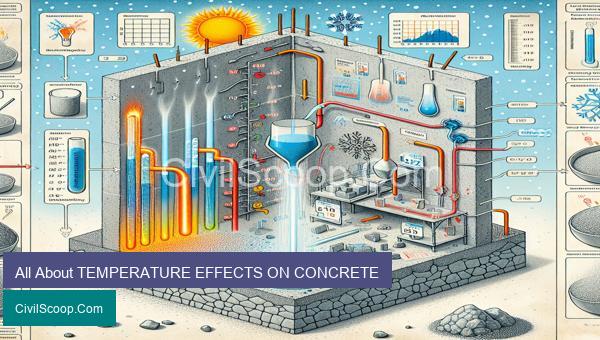
Concrete is the most widely used building material in the world, known for its strength and durability. However, it is also susceptible to temperature changes, which can greatly affect its properties and performance. In this article, we will delve into the various temperature effects on concrete, including how it can impact its strength, durability, and overall lifespan. We will also discuss the factors that contribute to these effects and how proper construction techniques can help mitigate them. With a better understanding of temperature effects, we can ensure the long-term stability and structural integrity of our concrete structures.
Table of Contents
TEMPERATURE EFFECTS ON CONCRETE

Temperature has a significant impact on the properties and behavior of concrete. As a civil engineer, it is important to understand and consider the effects of temperature on concrete during both the construction and service stages.
The process of concrete curing is strongly influenced by temperature. In a hot environment, the initial setting time of concrete tends to decrease, while in a cold environment, it can be delayed. The strength gain of concrete is also related to temperature, with higher temperatures resulting in faster strength development. This is due to the reaction between water and cement, which is exothermic and produces heat. In general, an increase in temperature can accelerate the curing process and decrease the time required for concrete to reach its desired strength.
However, extreme temperatures can also have negative effects on concrete. High temperatures can cause the loss of moisture, leading to shrinkage and cracking. This can be particularly problematic during the construction stage when concrete is exposed to high temperatures and wind. To prevent this, measures such as using shading or misting can be taken to keep the concrete from drying out too quickly.
In cold temperatures, the hydration process of concrete can be significantly slowed down, resulting in a decrease in strength development. If concrete freezes during the early stages, it can cause internal micro-cracking, which weakens the overall structure. Specific precautions need to be taken during colder seasons to ensure proper protection of concrete, such as using insulation and heating methods.
Another important consideration is the thermal expansion and contraction of concrete. As concrete is a rigid material, it expands and contracts with changes in temperature. This can cause tensile stresses, leading to cracking and distortion. Proper joint detailing and spacing need to be considered to manage these thermal movements and prevent damage to the structure.
Furthermore, repeated exposure to extreme temperature variations can lead to a phenomenon known as thermal fatigue. This is when the constant expansion and contraction of concrete cause cracks to form, and over time, it can compromise the strength and durability of the structure.
In summary, temperature has a direct effect on the curing, strength development, and durability of concrete. As a civil engineer, it is crucial to consider and account for the temperature conditions during the construction and service life of concrete structures to ensure their long-term performance. Proper precautions and measures need to be taken to protect concrete from extreme temperatures, such as using appropriate materials, joint detailing, and insulation methods. By understanding and managing the temperature effects on concrete, we can ensure safe and durable structures for our communities.
Conclusion
In conclusion, it is evident that temperature has a significant impact on concrete and its performance. Both high and low temperatures can cause significant changes in the strength, durability, and overall quality of concrete. It is crucial for engineers, contractors, and builders to understand these effects and implement appropriate measures to mitigate any adverse consequences. Proper mix design, curing techniques, and insulation methods are just some of the ways to ensure that concrete is not adversely affected by temperature fluctuations. With the increasing demand for sustainable and resilient construction, considering temperature effects on concrete is vital for long-lasting and durable structures. By carefully managing and controlling temperature, we can maximize the potential of concrete and improve its performance, ensuring that it continues to be a reliable and versatile building material.