
Perform rate analysis is an essential aspect of any construction project, especially when it comes to earth excavation. This process involves a systematic evaluation of the resources, time, and costs needed to carry out the excavation work efficiently. It provides a detailed breakdown of the tasks involved in earth excavation, allowing project managers to estimate the project’s budget and timeline accurately. In this article, we will delve into the concept of perform rate analysis for earth excavation, its significance, and the steps involved in conducting a successful analysis. By understanding this crucial process, construction professionals can make informed decisions and ensure the smooth execution of their projects.
Table of Contents
How to Perform Rate Analysis for Earth Excavation?
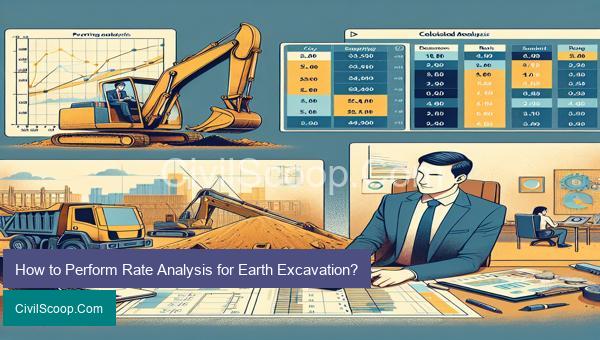
Rate analysis is an essential process in civil engineering projects, as it helps determine the cost of various construction activities. One such activity that requires rate analysis is earth excavation. This process involves removing soil, rock, and other materials from a construction site to make space for building foundations, driveways, and other structures.
Performing rate analysis for earth excavation is crucial, as it ensures accurate cost estimation and efficient project management. Here are the steps involved in conducting rate analysis for earth excavation:
1. Estimate the volume of earth to be excavated: The first step in rate analysis is to measure the amount of earth that needs to be excavated. This can be done by taking measurements of the length, width, and depth of the excavation area. The volume is then calculated using the formula V= L x W x D, where V is the volume in cubic meters, L is the length, W is the width, and D is the depth.
2. Determine the type of soil and excavation method: The type of soil and the method of excavation used will affect the rate of excavation. For instance, soft soil is easier to excavate than hard rock, and using heavy machinery will be more efficient than manual labor. It is essential to consider these factors while conducting rate analysis.
3. Calculate the time required for excavation: Based on the type of soil and excavation method, the time required for excavation can be estimated. For example, soft soil can be excavated at a rate of 0.75 to 1.25 cubic meters per hour using manual labor, while hard rock may require a rate of 0.2 to 0.35 cubic meters per hour using machinery.
4. Determine the equipment and labor cost: The next step is to calculate the cost of equipment and labor required for excavation. This will include the cost of machinery, such as excavators and trucks, and the cost of labor, including wages, benefits, and overhead costs.
5. Calculate the total cost of excavation: Once you have determined the volume, time, and cost of equipment and labor, you can calculate the total cost of excavation. This can be done by multiplying the volume by the time and adding the cost of equipment and labor.
6. Consider additional factors: Apart from the direct costs of excavation, there may be additional factors that need to be considered, such as site conditions, transportation costs, and waste disposal fees. These costs should be added to the total cost of excavation to get an accurate estimation.
7. Review and update the rate analysis: As the project progresses, it is essential to periodically review and update the rate analysis, as changes in soil conditions or excavation methods can affect the cost. This will ensure that the project stays within budget and any necessary adjustments can be made.
In conclusion, performing rate analysis for earth excavation is a crucial step in the planning and execution of a construction project. It helps in budgeting, cost control, and effective project management. By following the steps mentioned above, a civil engineer can accurately estimate the cost of earth excavation and ultimately contribute to the successful completion of the project.
Features of Rate Analysis of Earthwork Excavation
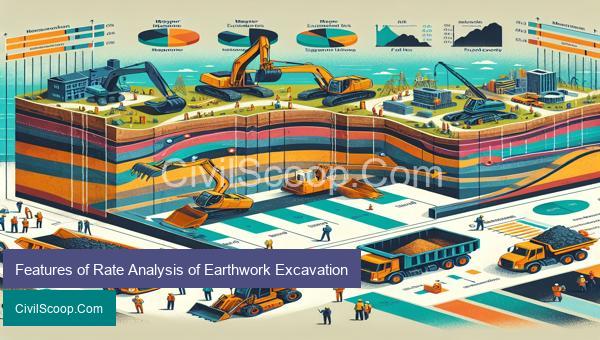
Rate analysis of earthwork excavation is a quantitative method used in the civil engineering field to determine the cost of digging, moving and placing soil. It is an essential process in construction projects, as earthwork excavation accounts for a significant portion of the total project cost. This analysis gives a detailed breakdown of the cost involved in every stage of earthwork excavation, helping project managers and engineers to plan and budget more effectively.
The following are some of the key features of rate analysis of earthwork excavation:
1. Detailed measurement of quantities: The first step in rate analysis of earthwork excavation is to accurately measure the volume of earth to be excavated. This is usually done by taking measurements of the length, width, and depth of the excavation site using different methods such as manual surveying or using advanced tools like total stations and GPS.
2. Classification of soil: The cost of excavation largely depends on the type of soil being excavated. Different types of soil have different densities, which affects the quantity of excavation and the difficulty level of the work. Rate analysis takes into account the soil type and classifies them into categories such as cohesive soil, non-cohesive soil, soft rock, and hard rock.
3. Calculation of excavation rate: Once the quantity and soil type are determined, the next step is to calculate the excavation rate. This is done by multiplying the volume of excavation by the unit rate of excavation, which is usually based on the type of equipment used and the difficulty level of the work.
4. Inclusion of transportation cost: After the excavation is done, the soil needs to be transported to a designated location. Rate analysis takes into account the distance to be covered and the mode of transportation to calculate the transportation cost.
5. Consideration of disposal cost: In many cases, the excavated soil is not used on-site and needs to be disposed of properly. Disposal costs, such as landfill fees, are included in the rate analysis to get a more accurate cost estimation.
6. Factor in labor and equipment cost: Earthwork excavation involves a significant amount of labor and equipment. Rate analysis factors in the cost of labor and equipment, such as excavators, bulldozers, and dump trucks, required for the excavation process.
7. Adjustment for contingencies: During excavation, unforeseen circumstances may arise, such as encountering unexpected water, rock, or other obstructions that can affect the cost. Rate analysis includes a contingency allowance to cover these unforeseen costs.
In conclusion, rate analysis of earthwork excavation provides a detailed cost estimation of this crucial aspect of construction projects. It takes into account all the related factors and ensures that project managers have a clear understanding of the cost involved, enabling them to make informed decisions and manage the project budget effectively.
Rate Analysis of Manual Earthwork Excavation

Rate analysis of manual earthwork excavation refers to the process of determining the cost of labor, materials, and equipment required for digging, moving, and removing earth by hand. This is an essential task in the field of civil engineering, as it helps in estimating the total cost of a project involving excavation work.
The following are the steps involved in conducting rate analysis of manual earthwork excavation:
1. Identification of scope of work: The first step is to identify the scope of work, i.e., the area to be excavated, the depth of excavation, and the type of soil. This information is necessary for calculating the volume of earth to be excavated.
2. Calculation of earth volume: Once the scope of work is determined, the next step is to calculate the volume of earth to be excavated. This can be done by using mathematical formulas based on the shape and depth of the excavation.
3. Estimation of labor cost: The labor cost is the most significant component of manual earthwork excavation. It includes the wages of the laborers, their transportation, and other miscellaneous expenses like food, accommodation, and safety equipment.
4. Evaluation of equipment cost: The cost of equipment used for excavation, such as shovels, picks, and wheelbarrows, also needs to be considered. The hourly rent of this equipment is calculated based on the depreciation value, maintenance costs, and fuel expenses.
5. Determination of material cost: Materials such as fuel, lubricants, and explosives, if required, are included in the excavation cost. Their cost can be estimated based on the quantity needed and current market rates.
6. Calculation of overheads and profit: Overheads include the costs associated with site supervision, administration, and project management. The profit margin is also added to the total cost, generally ranging from 10-15%.
7. Final rate analysis: After gathering all the necessary information and costs, the final rate analysis is prepared. It includes the item-wise cost of labor, materials, equipment, overheads, and profit. This provides an overall estimate of the excavation work.
Apart from the above steps, factors such as site accessibility, soil conditions, and the level of difficulty in excavation can also influence the rate analysis. The more challenging the site conditions, the higher the rate of excavation.
In conclusion, rate analysis of manual earthwork excavation is essential for estimating the total cost of a project and determining the feasibility of the construction. Civil engineers must conduct a thorough rate analysis to ensure accuracy and efficiency in cost estimation, enabling them to plan and execute projects within budget and on schedule.
Rate Analysis of Machinebased Earthwork Excavation

Rate analysis of machine-based earthwork excavation is the process of determining the cost of excavation activities using heavy machinery. This type of excavation is commonly used in construction projects where large volumes of soil and rocks need to be moved in a short period of time. The rate analysis helps in estimating the cost of the project and budgeting in an efficient manner.
The following factors are considered in the rate analysis of machine-based earthwork excavation:
1. Types of Equipment: The first step in the rate analysis is to determine the types of machinery required for the excavation work. The cost of equipment varies depending on the type, size, and efficiency of the equipment. Excavators, bulldozers, and dump trucks are some of the commonly used machinery in earthwork excavation.
2. Hourly rate: The hourly rate of the equipment plays a crucial role in the rate analysis. It includes the cost of fuel, maintenance, operator’s wages, and insurance. The hourly rate varies depending on the type of equipment and its efficiency.
3. Productivity: The productivity of the equipment is another important factor to consider in the rate analysis. It is the amount of work that can be completed in a given period. A more productive machine can complete the excavation work faster, which can impact the overall cost of the project.
4. Terrain and Soil Conditions: The type of terrain and soil conditions also affect the rate analysis. Excavation in rocky terrain or hard soil may require more powerful and expensive equipment, which can increase the cost of the project.
5. Depth and Volume of Excavation: The depth and volume of the excavation also play a key role in the rate analysis. A deeper and larger excavation requires more time, equipment and labour, which can significantly impact the cost.
6. Overhead Costs: Overhead costs such as site supervision, safety measures, and mobilization and demobilization costs should also be considered in the rate analysis.
Based on the above factors, the rate analysis is calculated by multiplying the hourly rate of the equipment with its productivity. The total excavation cost is then divided by the total volume of excavation to determine the rate per cubic meter of soil excavated. This rate per cubic meter can be used for budgeting and comparison with other methods of excavation.
In conclusion, rate analysis of machine-based earthwork excavation is an important aspect of project planning and management. It considers various cost factors and helps in estimating the overall cost of the project. A comprehensive rate analysis can assist in making informed decisions and ensuring the project is completed within the allocated budget and timeline.
Conclusion
In conclusion, performing a thorough rate analysis for earth excavation is crucial in ensuring the success and efficiency of any project that involves earthwork. It not only helps in accurately estimating the cost and time required for excavation but also allows for proper planning and budgeting. By understanding the various factors that affect the performance rate, such as soil condition, equipment efficiency, and labor productivity, project managers can make informed decisions and mitigate any potential risks. With advancements in technology and software, conducting a rate analysis has become easier and more accurate. Therefore, it is essential for construction professionals to familiarize themselves with the process and continually update their knowledge to achieve optimal results in earth excavation projects.