
Concrete is one of the most commonly used construction materials in the world and its strength is a crucial factor to ensure the structural integrity and long-term performance of a building or structure. The traditional way of measuring the strength of concrete is through compressive strength tests, which require preparing and testing concrete specimens in a laboratory. However, this can be a time-consuming and costly process, especially for large construction projects. As a result, the maturity method has become a popular alternative for estimating concrete strength in real-time. In this article, we will delve into the details of the maturity method and how it can be used to accurately determine the strength of concrete.
Table of Contents
How to Estimate Strength of Concrete through Maturity method?

Estimating the strength of concrete is an important process in civil engineering as it helps determine the durability and load-bearing capacity of structures. One method for estimating concrete strength is through the use of maturity, which is a measure of the concrete’s age and temperature over time. This method is based on the principle that the strength of concrete is directly related to its hydration kinetics, which is affected by temperature.
To estimate the strength of concrete through the maturity method, the following steps should be followed:
1. Determine the Maturity Index: The maturity index is a measure of the concrete’s age and temperature over time. It is calculated using the following equation: MI = (T-Tb) x Tf
where MI is the maturity index, T is the concrete temperature, Tb is the baseline temperature (usually taken as 10°C), and Tf is the time factor which depends on the type of cement used.
2. Measure the Maturity Factor: The maturity factor is the relationship between maturity index and the compressive strength of concrete. It can be obtained from a maturity curve, which is developed by conducting laboratory tests on concrete samples. The maturity factor is usually expressed in Kpsi-1/2 or MPa-1/2.
3. Determine the Maturity Index at Desired Strength: Based on the desired compressive strength of concrete, the corresponding maturity index can be determined using the maturity factor. For example, if the maturity factor is 5 Kpsi-1/2 and the desired strength is 4000 psi, the maturity index would be 800 (4000/5).
4. Monitor the Temperature: To accurately estimate the strength of concrete, it is important to monitor the temperature during the curing period. The temperature can be measured using embedded thermocouples or a temperature sensor attached to the surface of the concrete.
5. Calculate Cumulative Maturity: Cumulative maturity is calculated by multiplying the maturity index by time. This gives an indication of the rate of strength gain of the concrete. For example, if the maturity index is 800 and the concrete has been curing for 7 days, the cumulative maturity would be 5600 (800 x 7).
6. Determine the Strength: Once the cumulative maturity has been calculated, it can be compared to the maturity curve to estimate the compressive strength of the concrete. The maturity curve should be developed for the specific mix design and curing conditions.
It is important to note that the maturity method is most accurate when used for concrete with similar mix designs and curing conditions as the samples used to develop the maturity curve. If there are significant differences, the results may not be accurate.
In conclusion, the maturity method is a practical and efficient way to estimate the strength of concrete. It can help civil engineers determine the optimum time for concrete removal and can also be used to monitor the progress of strength gain during curing. However, it is important to validate the results by conducting laboratory tests on concrete samples to ensure accuracy and reliability.
Concrete Maturity and Maturity Method on Concrete

Concrete maturity refers to the level of concrete’s strength and stiffness at a given age. This is an important factor in construction as it determines when the concrete can be safely loaded and supports structural integrity. The maturity of concrete can be affected by various factors such as temperature, humidity, and mix design.
One method used to measure concrete maturity is the Maturity Method. This approach is based on the principle that the strength of concrete is directly related to its developed time and temperature history. By measuring the internal temperature of the concrete, the maturity method can accurately determine the actual strength of the concrete at any given age.
The Maturity Method involves the use of temperature sensors placed within the concrete at the time of casting. These sensors continuously monitor the internal temperature of the concrete, and using a specific formula, the maturity index can be calculated. The maturity index is a numerical value that represents the combined effect of time and temperature on the development of concrete’s strength.
By using the maturity index, the strength of the concrete can be predicted at any desired age. This information is crucial for construction purposes as it allows engineers to determine when the concrete can safely support loads. This method is especially useful in situations where the curing time of concrete is accelerated due to high temperatures or where there are limitations on the traditional method of testing concrete strength.
The Maturity Method offers several benefits compared to traditional methods of testing concrete strength. These include faster and more reliable results, cost-effectiveness, and improved safety. By eliminating the need for destructive testing, the method also reduces the risk of damage to the structure.
Moreover, the maturity method can be used to monitor the effectiveness of concrete curing. By continuously monitoring the maturity index, construction teams can ensure that the concrete is curing properly and achieving the necessary strength for its intended use.
In conclusion, concrete maturity and the Maturity Method play a significant role in construction and are important considerations for engineers. This method offers a more efficient and accurate way to measure concrete’s strength, providing valuable information for safe and successful construction.
Principle of Maturity Method for Concrete Testing
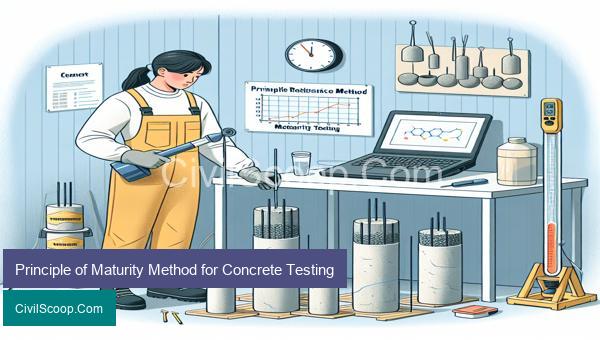
The principle of Maturity Method is a widely used approach for assessing the strength development of concrete over time. It is based on the concept that the strength of concrete is directly related to its hydration process, which is the chemical reaction between water and cement. The Maturity Method provides an effective and efficient way to monitor and predict the strength gain of concrete without the need for destructive testing.
The principle behind the Maturity Method is that the rate of concrete strength gain is directly proportional to the temperature-time history of the concrete. This means that the strength of concrete at any given time is determined by the temperature profile that the concrete has been subject to during its curing process. The higher the temperature, the faster the strength gain will be.
The Maturity Method involves measuring the temperature history of the concrete through sensors embedded within the concrete itself or attached to its surface. These sensors record the internal temperature of the concrete at specific time intervals. The recorded data is then used to calculate the maturity index, which is a measure of the cumulative effects of temperature and time on the concrete.
Once the maturity index is determined, it can be compared to calibration curves, which are generated through laboratory tests of concrete samples cured at different temperatures. These curves represent the relationship between the maturity index and the compressive strength of concrete at various ages. By comparing the maturity index of the in-place concrete to the calibration curves, the strength of the concrete at any age can be estimated.
The Maturity Method is particularly useful in situations where early strength gain is critical, such as in cold weather conditions or in projects with tight construction schedules. It allows engineers to accurately predict the strength of concrete and determine the ideal times for formwork removal, post-tensioning, and other construction activities.
In addition to strength prediction, the Maturity Method can also be used to detect any potential issues with concrete, such as low temperature, inadequate curing, or poor quality materials. By monitoring the temperature profile of the concrete, any abnormalities can be identified and corrective actions can be taken before they affect the overall strength and durability of the structure.
The Maturity Method has been recognized by various industry standards, including ASTM C1074, and has been extensively used in the construction of bridges, tunnels, high-rise buildings, and other infrastructure projects. Its reliability, accuracy, and cost-effectiveness make it a preferred method for concrete testing by civil engineers worldwide.
Maturity Method Steps for Concrete Testing

The Maturity Method is a widely used technique for estimating the strength of concrete in construction projects. It is a non-destructive and time-efficient approach that relies on the relationship between concrete strength and its maturity, which is a measure of the concrete’s age and curing temperature. This method can be used for various types of concrete structures, including buildings, bridges, and dams. The following are the steps involved in conducting the Maturity Method for concrete testing:
1. Selection of Maturity Function: The first step in the Maturity Method is to determine the maturity function, which is a mathematical relationship between the strength of concrete and its maturity. This function can be obtained from the concrete mix design or by conducting a calibration test on the specific concrete used.
2. Placing Temperature Measurement Devices: The next step is to place temperature measurement devices, such as thermocouples or maturity meters, at different locations in the concrete pour. These devices will record the temperature of the concrete as it cures.
3. Recording Concrete Temperature: The temperature of the concrete is to be recorded at regular intervals, usually every hour, until it reaches its final strength. This data is used to calculate the concrete’s maturity using the maturity function.
4. Determining Concrete Maturity: Once the temperature measurements are recorded, the concrete’s maturity is calculated using the maturity function. This value is an indicator of the concrete’s strength development and is expressed in units of degree-hours.
5. Correlating Maturity with Concrete Strength: The next step is to correlate the concrete’s maturity with its strength by conducting strength tests on core samples at different maturity levels. This data is used to develop a maturity-strength relationship specific to the concrete mixture being used.
6. Estimating Concrete Strength: Based on the maturity-strength relationship, the concrete’s strength can be estimated at any given maturity level, which is a function of the curing temperature.
7. Monitoring Concrete Curing: The Maturity Method allows for real-time monitoring of concrete curing, enabling engineers to make timely decisions on when to remove formwork, apply loads, or proceed with construction activities.
8. Verification of Results: The final step in the Maturity Method is to verify the estimated concrete strength using traditional testing methods, such as compressive strength tests on core samples. This helps to validate the accuracy of the results obtained from the Maturity Method.
In conclusion, the Maturity Method is a practical and efficient technique for estimating the strength of concrete in construction projects. By following these steps, engineers can ensure the quality and reliability of concrete structures, saving time and resources in the process. However, it is essential to note that this method is highly dependent on the accuracy of temperature measurements, and proper calibration of the maturity function is crucial for obtaining accurate results.
Advantages of Maturity Method Test on Concrete

The Maturity Method Test is a widely used non-destructive technique for evaluating the strength and maturity of concrete. It is a reliable and convenient method for monitoring and predicting the strength of concrete at different ages without having to wait for extensive laboratory tests. This method is based on the principle that the strength of concrete is directly related to its age and temperature exposure.
Here are some of the advantages of using the Maturity Method Test on concrete:
1. Saves Time and Cost: The traditional method of testing concrete strength involves casting and testing of concrete specimens in a laboratory, which can be time-consuming and costly. The maturity method eliminates the need for laboratory testing, saving both time and money.
2. Non-Destructive: The Maturity Method Test does not require the destruction of concrete samples. This means that the integrity of the structure is not compromised, and it can continue to be used for its intended purpose.
3. Accurate Results: The maturity method is highly accurate and reliable in predicting concrete strength. It takes into account the effects of temperature, humidity, and curing time, which are the key factors influencing the strength of concrete.
4. Real-Time Monitoring: The Maturity Method Test is a real-time monitoring technique, which means that the strength of concrete can be continuously monitored during the curing process. This provides valuable information for making decisions about the project schedule, formwork removal, and construction progress.
5. Suitable for Different Products: The Maturity Method Test is suitable for a wide range of concrete products, such as slabs, walls, beams, and columns. It can also be used for different types of concrete, including normal concrete, lightweight concrete, and high-strength concrete.
6. Easy to Use: The Maturity Method Test is a simple and user-friendly technique that can be performed on the construction site by using handheld devices. This makes it a convenient method for contractors and project managers to use at any stage of the construction process.
7. Quality Control: The Maturity Method Test can be used as a quality control tool to ensure that the concrete has reached the desired strength before removing formwork or applying loads. This helps to prevent potential issues and delays in the construction process.
In conclusion, the Maturity Method Test has many advantages over traditional methods of testing concrete strength. It is a time-efficient, cost-effective, and accurate technique that can provide real-time monitoring and quality control, making it a valuable tool for civil engineers in the construction industry.
Conclusion
The Maturity method is a reliable and efficient way to estimate the strength of concrete without having to wait for traditional curing times. By using the principle of concrete maturity, concrete professionals can accurately predict the compressive strength of the material at any point in its curing process. This method not only saves time and resources, but also ensures the quality and durability of the concrete structure. As with any testing method, proper implementation and monitoring are crucial for accurate results. By following the proper procedures and utilizing the technology available, the Maturity method can be a valuable tool for construction projects. It is clear that the Maturity method has revolutionized the way we estimate concrete strength, and will continue to be an integral part of the industry in the future.